Increasing FAFSA Completion in Florida: A Playbook for Success
Introduction
Helios Education Foundation is dedicated to enriching the lives of individuals in Arizona and Florida by creating opportunities for success in postsecondary education. According to the National College Access Network, high school seniors who complete the Free Application for Federal Student Aid (FAFSA) are 63 percent more likely to enroll in postsecondary education than students who do not complete the FAFSA. Helios Education Foundation, along with many organizations throughout Arizona and Florida, has prioritized FAFSA completion as a key strategy to encourage all students – but especially those from first-generation, minority, and underrepresented communities - to pursue postsecondary education. This brief is the result of a collaborative partnership between Helios and the Florida College Access Network to provide valuable information and resources to help support FAFSA completion in Florida.Overview
What is the FAFSA and Why is it Important?
Overview
FAFSA stands for Free Application for Federal Student Aid. It enables students and families to apply for federal student aid, such as grants, work-study, and loans. Together, these types of federal student aid amount to the largest source of financial aid available to help students pay for college. FAFSA stands for Free Application for Federal Student Aid. It enables students and families to apply for federal student aid, such as grants, work-study, and loans. Together, these types of federal student aid amount to the largest source of financial aid available to help students pay for college. Completing and submitting the FAFSA is free and easier than ever, and it gives students access to the largest source of financial aid to pay for college or career school. In addition, many states and colleges use FAFSA information to determine eligibility for state and school aid, and some private financial aid providers may use FAFSA information to determine whether students qualify for aid. Learn more >>Benefits
Florida Attainment Rates
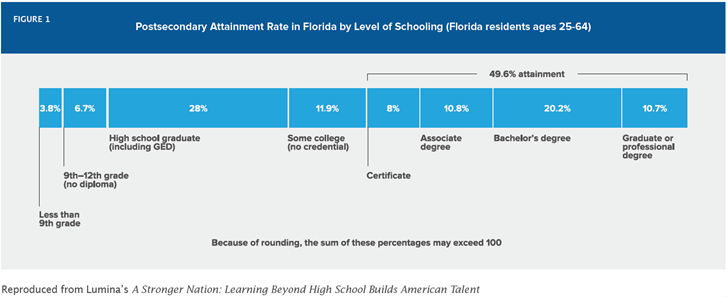
Florida is at a critical juncture in determining its economic future. Currently, only 49.6% of Florida’s population holds a certificate, or associates degree or higher (See Figure 1 below). For minorities, this proportion is even lower. For example, 30.1% of African Americans have a certificate or higher and 36.2% of Hispanics do so. In contrast, 45.4% of Whites in Florida have a postsecondary certificate or higher. Yet, according to the Georgetown Public Policy Institute, more than 68 percent of Florida jobs will require at least some amount of postsecondary education by 2020 (Carnevale, 2013). Considering the importance of postsecondary education attainment, a critical question the state must answer is: How can Florida increase postsecondary opportunities to further economic prosperity and viability? One of the most obvious ways to increase economic opportunities is to increase the proportion of high school students matriculating to college after graduation. Yet, over the last four years, the college going rate in Florida has been relatively flat with a sharp decline in 2019. According to a report released by the National Student Clearinghouse, between 2018-2019 Florida saw the largest dip in enrollment (-5.2%) among degree granting institutions nationwide (National Student Clearinghouse Research Center Term Enrollment Estimates 2019). One set of strategies that has tremendous potential to increase postsecondary enrollment are those focused on increased FAFSA completion rates. Prior research out of the National Center for Education Statistics shows that roughly 90% of high school seniors who complete the FAFSA attend college directly after high school, compared with 55% of non-completers. Because of this strong association between FAFSA completion and college-going, many organizations and states have implemented FAFSA challenges or completion campaigns to increase the proportion of students going to college directly after high school. For example, the National College Access Network led a 2016-2017 FAFSA completion challenge in 22 cities across the country. Overall, NCAN’s grantees increased completion by 10% in two years (NCAN Why Invest in Increasing FAFSA, 2017).